CRO Methodology
The Dalayon CRO loop has four stages: Investigation, Research, Optimization, and Evaluation. The goal is to move from evidence to action without turning every opinion into a test.
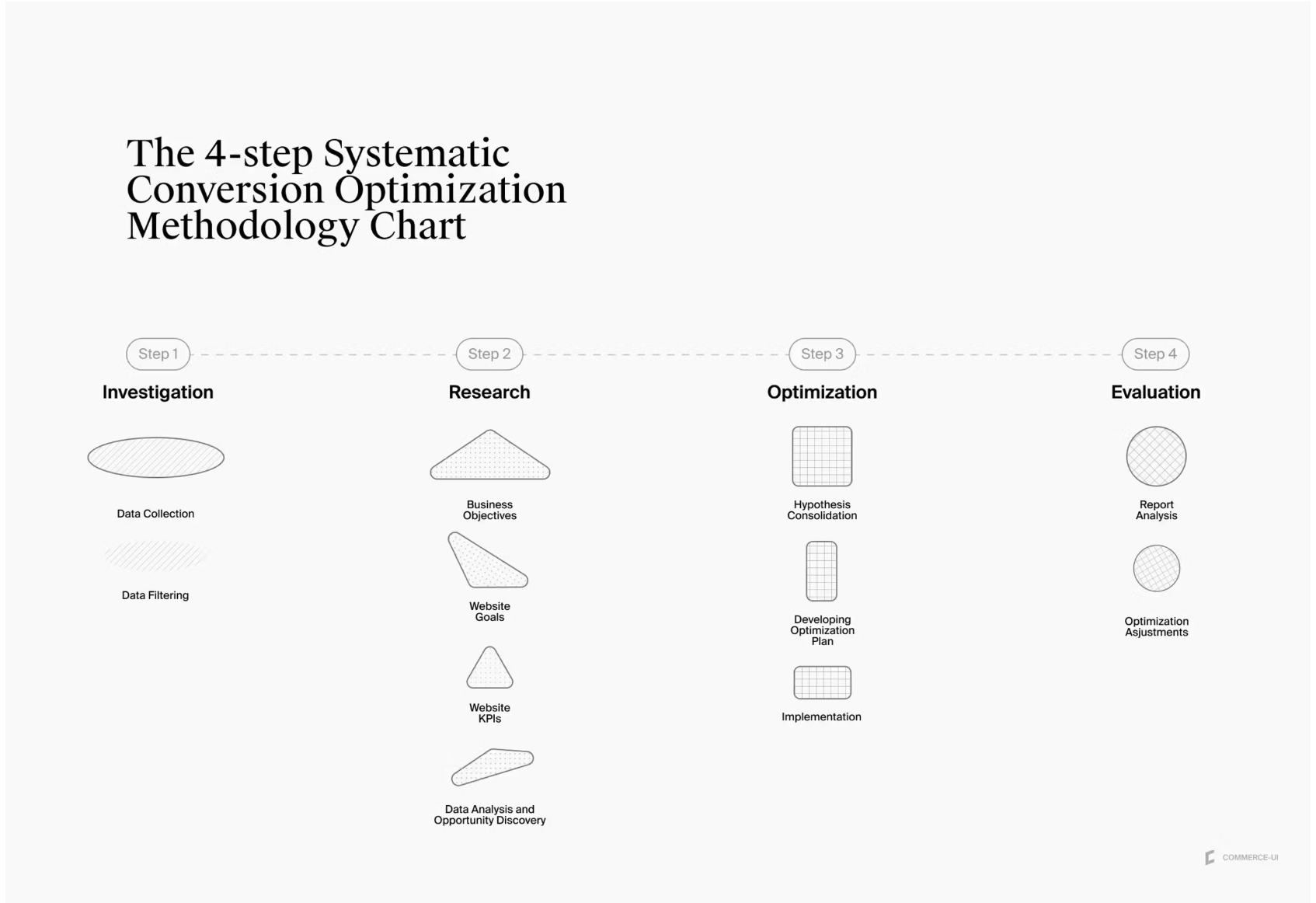
The Loop
| Stage | Purpose | Typical Inputs | Output |
|---|---|---|---|
| Investigation | Find where performance is leaking | Analytics, funnel data, page speed, product performance, customer journey notes | Prioritized problem list |
| Research | Understand why the leak may exist | Session recordings, heatmaps, customer language, reviews, support tickets, competitor scan | Evidence-backed hypotheses |
| Optimization | Ship the smallest useful improvement | Test design, mockups, theme changes, QA checklist, launch plan | Experiment or direct rollout |
| Evaluation | Decide what to keep, change, or stop | Test results, pre/post read, revenue per visitor, CVR, ATC, AOV, qualitative notes | Decision log and next action |
Principles
- Start with a business question, not a tactic.
- Separate traffic quality problems from on-site conversion problems.
- Prefer clear measurement windows over noisy snapshots.
- Treat every result as directional until the sample is strong enough.
- Record the decision, not just the numbers.
When To A/B Test
Use an A/B test when the change is reversible, traffic is sufficient, and the outcome is uncertain enough to justify splitting traffic.
Use a direct rollout when the change is clearly corrective, required for brand or technical reasons, or the traffic level cannot support a useful test. In that case, write a pre/post measurement plan before launch.
Standard Decision States
| Decision | Meaning |
|---|---|
| Roll out | Variant clearly improves the primary metric and does not create a material trade-off |
| Keep control | Variant underperforms or adds risk without enough upside |
| Iterate | Signal is promising but the variant needs adjustment |
| Re-run | Data quality, tracking, timing, or sample size makes the result unreliable |
| Monitor | Direct rollout shipped and needs a clean post-launch read |